
Is Writing Indulgent?
A Mother's Fight to Write

Many years ago, whilst sitting in a Wetherspoons pub with two friends, we found ourselves sipping coffee after our meal, talking about "what's next". We'd walked similar faith journeys and were now busy with homes, husbands, children, and serving in the local church.
At the time, we were in our late thirties or early forties, talking about the dreams we'd tucked away for another season. One wanted to train as a midwife, another wanted to open her home and become a foster carer, and I wanted to write and publish.
We talked about our aspirations and the barriers to them. For my friends, it simply wasn’t quite the right time in their stage of family life.
Then one of them turned to me and asked, “So what’s stopping you?”
I paused before replying, “I don’t know. I can’t get past the feeling that writing is... indulgent.”
Reflecting on that conversation now, I’m horrified that I ever said that out loud when words have become as essential to me as air and water. But I can also understand why younger Leah, a mother of many and trained for ministry, saw writing as gelato on a hot Mediterranean afternoon rather than bread for the hungry.
❧
I’m embarrassed to tell you the excuses I’ve voiced and allowed to reside in my mind about why I didn’t sit down to write. I mean, some were legitimate, like the baby was crying and needed feeding. But when you tell yourself you can’t write because your office isn’t tidy, there’s laundry on the landing, or, even worse, I have a meeting at 2pm, so I can’t possibly start now (it’s hypothetically 9am, for the sake of the example), you begin to realise something else is going on. I can’t think straight. I haven’t showered. I can’t find a black pen; therefore, I must sort out all the pens in the house.
To add insult to injury, I somehow come up with the most detailed, intricate homemaking plans whenever I have a writing deadline looming.
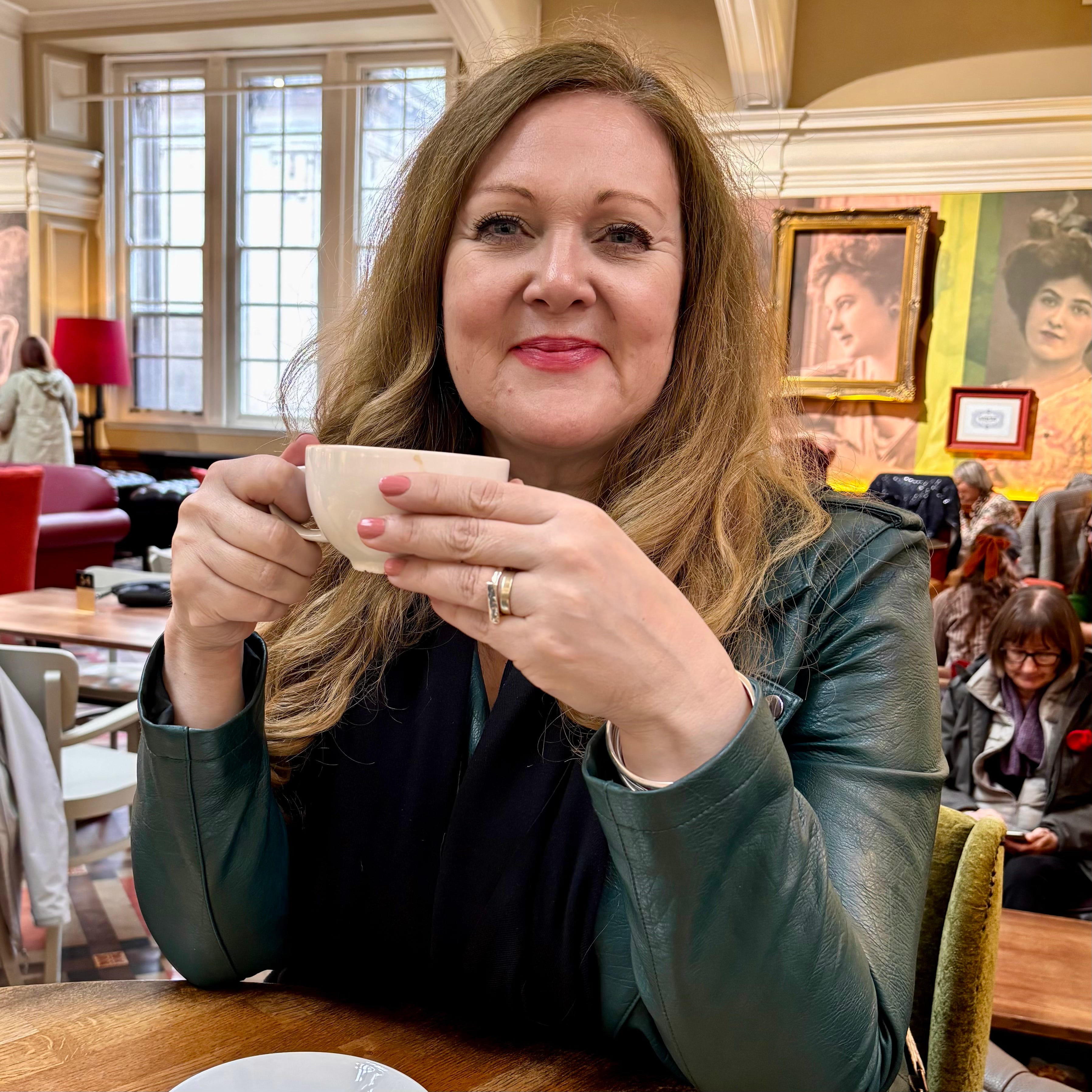
Words on a page have felt important to me for as long as I can remember. When I was fourteen, I wrote letters and kept a diary. In my early twenties, I wrote poetry whilst travelling across America and Australia during my university summer breaks. In my late twenties, I wrote songs and blog posts. In my thirties, I wrote website articles and workshops, and as I tipped into my fourth decade, I self-published an eBook of essays about motherhood (don’t look for it; it’s not there anymore). In my forties, I wrote conference talks and published four books with two major Christian publishers.
I didn’t fall into writing. It didn’t just happen. No. This beautiful privilege has been worked for, thought about upon waking, and has remained impossible to shake through every decade. But it hasn’t been easy.
My fight to write was contended for in the fringe hours of family life and thought about whilst washing dishes. I’ve written essays in my head while driving children to singing lessons, poetry whilst waiting to collect them from youth group, and vignettes whilst walking the dog for the third time that day. I’ve woken with words and ideas and tapped them into a note on my phone, knowing they might one day be woven into a sentence when time and responsibility allowed. And at 5pm, no matter whether I'm in the flow or have just had the best idea of the day, I stop. Dinner must be started. Vegetables need chopping, sauce needs stirring, and the table needs setting.
I became fully alive to my desire to write just as children were added to our family. As my family grew, so did my longing to put language to my life, and I found myself living in the tension between creative yearning and maternal responsibility.
Most mothers are gifted with a heightened sense of responsibility. The midwifery team hand it to you with your Bounty Pack and Emma's Diary,* and there's an absolute no-returns policy! I'm very aware of my own heightened sense of responsibility. I've also spent more than enough time, both in person and via voice note, exploring my fascinating "do all the things" personality with friends. According to some birth-order theorists, my brother being five years older than me more or less resets the birth order, giving me eldest-child vibes, which, bless our hearts, apparently puts us in charge of the world. But no matter what Myers-Briggs, Alfred Adler, or the Enneagram says about your personality, when you have mouths to feed, lives to keep alive, a home to clean, pets to tend to, and a community to cultivate, these acts of making are often pushed further away, leaving a deficit in our souls and our hands.
❧
Perhaps the questions ringing in my mind were echoes of the youth camp altar calls and the missionary books I had devoured as a teenager: How could writing be missional? Helpful? Transformational?
How could writing possibly compare to bringing babies into the world and caring for postpartum mothers? How could it come close to welcoming neglected and lonely children into your home and your heart, only to face the gut-wrenching task of letting them go again?
Perhaps I’d misunderstood what beautiful words were for. If someone like Dostoevsky, a man acquainted with suffering who once stood before a firing squad believing his life was over, could write that “beauty will save the world,” then perhaps even my words could offer a little hope too.
Thankfully, there was hope for this writer. When I sat down to write the Tales of Boldness and Faith series, I was slowly emerging from what had felt like a lifetime of home educating back into the world of work and publishing. My assignment was to write three books for middle-grade children in eighteen months, and I quickly realised that my old mindset wasn’t going to work. I had to silence the excuses and take the sage advice of Anne Lamott:
“How to write: Stop not writing. Get and keep your butt in the chair.”
So I did.
I took my laptop to Starbucks. I’m not a huge fan of their coffee, but everyone seems quite happy for you to write there. I wrote on the sofa, in bed, in my lunch breaks from my part-time job, in my park view office, and at the dining room table after moving the pile of laundry vying for my attention to one side. I see you, I’d say. I know you’re there. I’ll get to you next. I opened my MacBook and picked up where I’d finished the day before. I stopped waiting for the perfect conditions and began writing wherever life did or did not allow.
“You were made and set here to give voice to this, your own astonishment”
- Annie Dillard
As the words came, and the lives of C. S. Lewis, Charlotte Mason, and Sara Forbes Bonetta opened up before me, so did the realisation that this, too, was missional. This, too, was an act of service. This, too, had the capacity to transform.
With each book I write, once the pages are printed and there is no going back, I dedicate it to the Lord and pray over every reader I will never meet. It was at that point, through these books, that my eyes were opened to the fact that writing, like midwifery or fostering, has the capacity to carry hope into places I will never reach myself.
Soli Deo gloria.
❧
And for the curious, my Wetherspoons friends are indeed living out that conversation; in fact, we all are. One has welcomed many babies into her home until they found their adoptive families, and the other is a fully trained and practising midwife. And I? Well, I still think writing is a delicious and necessary indulgence. It's in my thoughts and dreams, my fingers, veins and my breath, and I'll do it until my last.
*For my non-UK readers: Bounty and Emma’s Diary are the complimentary packs almost every new parent receives in UK maternity units, filled with baby samples, vouchers, and parenting information.
Need a nudge?
Perhaps this is your invitation to stop waiting for the perfect conditions and start writing.
If you’ve spent years gathering beautiful words, filling notebooks with quotations, or wondering whether you should write, I’d love to spend some time with you.
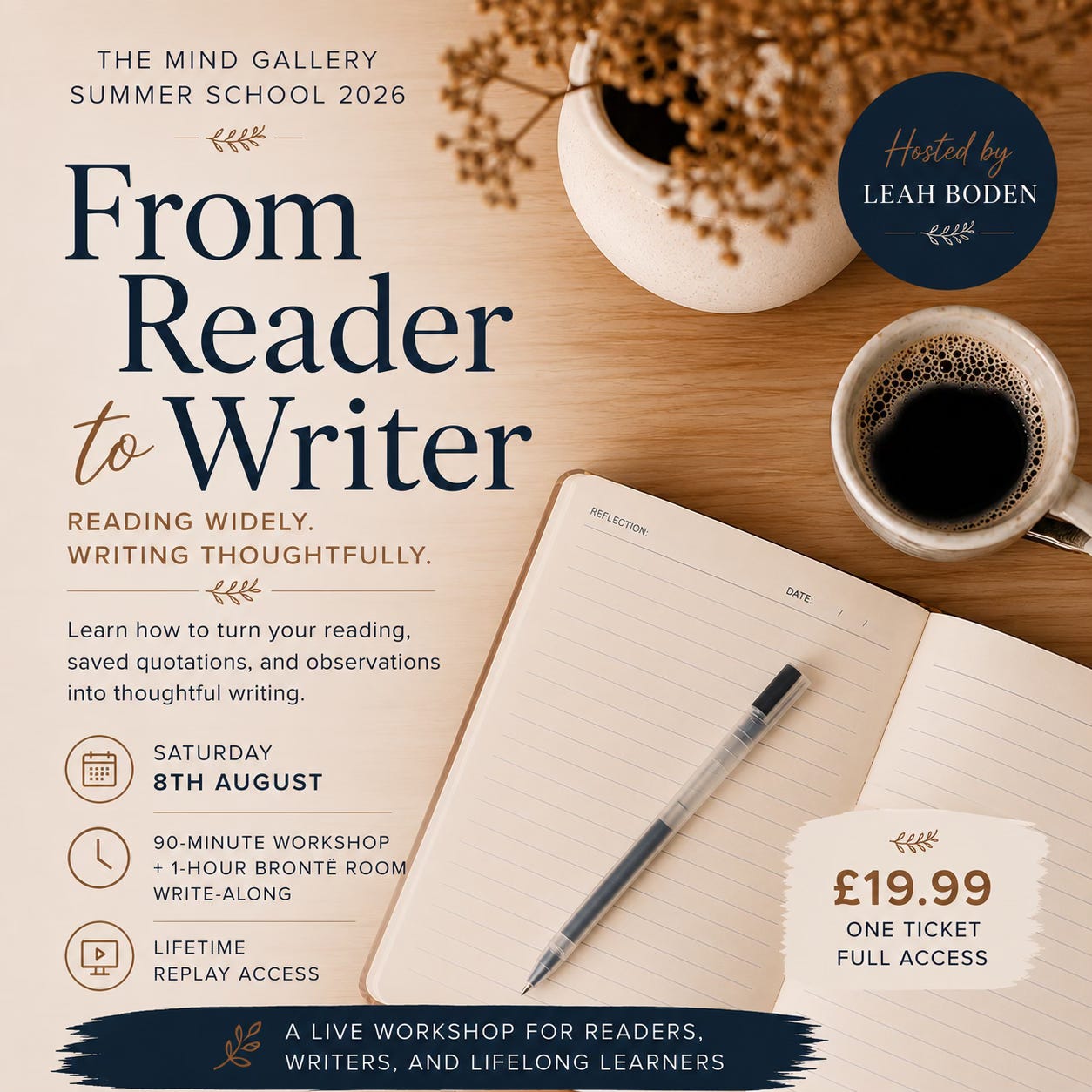
In my brand new workshop, From Reader to Writer: Reading Widely. Writing Thoughtfully, we’ll explore how the books we love, the observations we make, and the words we store can become writing that nourishes us and encourages others. Then we’ll gather in my digital co-working space, The Brontë Room, for an hour of writing together, putting into practice what we’ve learnt and permitting ourselves to begin.
All the details are on the Eventbrite page. If you can’t join us live, don’t worry—you’ll receive lifetime access to the replay, so you can enjoy the workshop whenever it suits you.
I’d love for you to join me.
This piece is exquisite, Leah! Your words are a gift to the world! And I think this is true of so many creative practices from sewing to photography to growing flowers to baking sourdough. I remember people would ask me why I would sew clothes when it was less expensive to buy them. Gosh there are so many ways I could answer that but one at the top is for the joy of doing it.
Oh this is funny...I've just sat down with my laptop open for the first time in many months. I thought - 'oh I might just write a little substack article, be brave, give myself an hour or so'...then I froze, thought I might just read a few instead...but then I stumble across this beautifully encouraging piece. Thank you Leah. I might actually start writing.